5 Best Keyword Research APIs: Compared by a Senior SERM Expert


If you’re building an SEO tool, scaling a reporting pipeline, or running automated site audits across dozens of client accounts, you need programmatic access to keyword data. The best keyword research API depends on your stack: how many queries you run, what data points you need, and what your budget is per unit of output.
Table of Contents
This article covers five keyword research tools API options that hold up under real workloads — SE Ranking, Ahrefs, Semrush, SpyFu, and Keywordtool.io. Each has been evaluated against use cases in SaaS, e-commerce, IT services, and outsourcing. No filler. Just what you need to make the call.
What Is the Best Keyword Research API?
SE Ranking Keyword Research API is the best overall keyword research API for most SERM professionals and agency teams in 2026. It gives you keyword volume, difficulty scores, SERP data, competitor keyword sets, and suggestion endpoints — all through a clean REST interface. Pricing starts at a $50 minimum deposit and scales without the punishing per-unit costs that make Ahrefs or Semrush expensive at volume. If you run an api keyword research workflow across multiple client domains, SE Ranking gives you the data depth of the enterprise tools at a fraction of the access cost. It’s a strong seo keyword research api for teams that need reliable data without building a finance case every time they want to run a batch job.
Full Comparison Table of the Best Keyword Research APIs
| Tool | Free Tier | Keyword Volume | Keyword Difficulty | Suggestions | Competitor Data | Rate Limits | Starting Price | Best For |
| SE Ranking API | Yes (limited) | Yes | Yes | Yes | Yes | Plan-based | $50/mo | Agencies, SaaS |
| SpyFu API | No | Yes | Limited | Yes | Yes (strong) | Plan-based | $39/mo | PPC + SEO overlap |
| Ahrefs API | No | Yes | Yes | Yes | Yes | Unit-based | $500+/mo | Enterprise SEO |
| Semrush API | No | Yes | Yes | Yes | Yes | Unit-based | $139.95/mo | Full-suite teams |
| Keywordtool.io API | No | Yes (plus) | No | Yes | No | Plan-based | $89/mo | Long-tail mining |
1. SE Ranking API
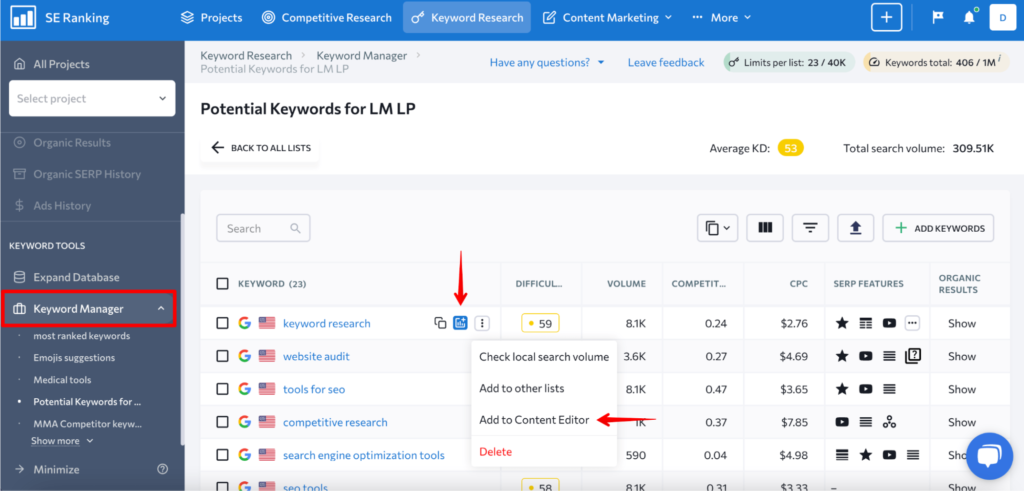
SE Ranking is a full-featured SEO platform with a REST API that exposes keyword research, rank tracking, backlink data, and site audit functionality. The keyword-specific endpoints cover volume, CPC, competition, difficulty, SERP features, and related keyword suggestions. Used extensively in agency and SaaS environments where programmatic access to SEO data is a core workflow requirement.
What Are the Key Features of SE Ranking API?
- AI search visibility tracking across Gemini, Google AI Mode, Google AI Overviews, Perplexity, ChatGPT
- Keyword volume and CPC data across Google, Bing, and YouTube
- Keyword difficulty scores with SERP-level breakdown
- Related keyword and keyword suggestion tool api functionality built into the suggestions endpoint
- Competitor keyword gap data accessible via the API
- Rank tracking via API with historical position data
- Site audit endpoint for technical SEO automation
- White-label support for agency reporting pipelines
- REST architecture with JSON responses and straightforward authentication
What Are the Pros and Cons of SE Ranking API?
Pros:
- Competitive pricing relative to Ahrefs and Semrush at equivalent data volumes
- Covers the full seo keywords api stack — keyword research, rank tracking, backlinks, and audits in one place
- Clean REST endpoints with good documentation
- Keyword suggestion endpoint works well for building topical clusters programmatically
- Free tier available for testing and low-volume workflows
Cons:
- Database size is smaller than Ahrefs and Semrush for some international markets
- SERP volatility data is less granular than Semrush’s API
- No first-party SDKs
What Is the Pricing of SE Ranking API?
- The pay-as-you-go tier requires a $50.00 minimum deposit for 250,000 credits
- Core Plan ($129/month or $103.20 billed annually): 10 projects & 1 seat, 2,000 keywords + 100 prompts daily, 5 GEO domains, 250k audit pages/month, 25k API credits with MCP access, rank tracking, unlimited keyword/backlink research, site audit, and integrations (GA, GSC, Looker Studio, Matomo)
- Growth Plan ($279/month or $223.20 billed annually): 30 projects & 3 seats, 5,000 keywords + 250 prompts daily, 15 GEO domains, 2M audit pages/month, 100k API credits with MCP access, all Core features plus historical data, collaboration tools, page monitoring, and dedicated support
- Agency Pack (+$69/month, annual): add-on with 30 projects, 30 client seats, full white-label platform & reports, unlimited scheduled reports with AI summaries, agency catalog placement, and lead generator
- AI Search Add-on ($89/month or $71.20 annually): 200 prompts, tracking across AI platforms (ChatGPT, Perplexity, AI Overviews), unlimited competitor research, SE Visible dashboard, and automated reporting
- API Add-on ($149/month, annual): 12M credits, access to backlinks, domain analysis, keyword research, AI search, and website audit APIs for automation
- SMM Platform (from $33/month): social media scheduling, collaboration workflows, content planning, analytics, and asset management
- SEO Data API (from $179/month): standalone API with scalable volume, access to backlinks, domains, AI search queries, MCP integration, and automation via tools like Looker Studio, n8n, and Make
- 24M Credits Plan ($318/month effective): 24M credits/year (billed $3,816/year upfront), suitable for large-scale API usage and automation workflows
Best Use Cases of SE Ranking API
- Agencies managing 20+ client accounts who need automated keyword research tools api reporting
- SaaS products that need embedded keyword data without reselling Semrush or Ahrefs licenses
- E-commerce teams building internal keyword monitoring dashboards
- IT and outsourcing firms running keyword audits at scale across CMS migrations
- Developers building white-label SEO reporting tools
2. SpyFu API
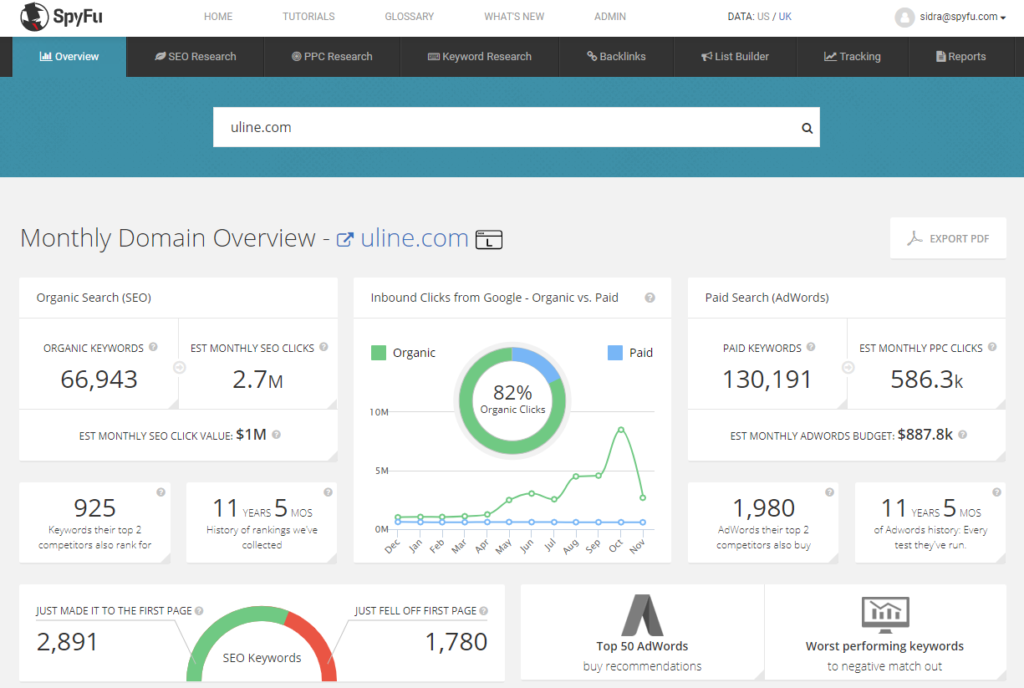
SpyFu is best known for competitive intelligence — specifically exposing the paid and organic keyword history of any domain. Its API surfaces that same data programmatically. It’s been around since 2006 and has a solid track record in PPC-adjacent SEO work. The api keyword tool functionality is narrower than SE Ranking or Semrush, but the competitor keyword data is genuinely strong.
What Are the Key Features of SpyFu API?
- Domain keyword history for organic and paid results going back years
- Competitor keyword overlap and gap analysis
- Keyword suggestion api endpoints tied to seed keywords and domains
- Estimated monthly search volume and CPC data
- Ad history and spend estimates per keyword
- Top pages data showing which URLs rank for which terms
- Batch domain lookup for bulk competitive research
What Are the Pros and Cons of SpyFu API?
Pros:
- Strongest competitor-focused keyword data among the tools in this list
- Good historical depth — keyword ranking history is more extensive than most platforms
- Affordable entry-level pricing at $39/month
- Useful for PPC teams who need keyword tools api access to both organic and paid data
Cons:
- Primarily US-focused; international keyword data quality drops significantly
- No keyword difficulty score in the standard API response
- Less useful as a pure keyword suggestion tool api compared to dedicated research platforms
- API documentation is less polished than Ahrefs or Semrush
What Is the Pricing of SpyFu API?
- Basic Plan ($39/month): 10k search result rows, 10k exports, 1 live tracking project, 10+ years historical data, RivalFlow (0 sites), ChatGPT integration, AI brand monitoring, 5k weekly keyword tracking, 10 automated reports, Google Ads templates, GSC integration, white-label reporting, API access, 1 user
- Pro + AI Plan ($59 first month, then $119/month): unlimited search results & exports, 10 tracking projects, 10+ years historical data, RivalFlow (1 site), ChatGPT integration, AI brand monitoring, 15k weekly keyword tracking, 100 automated reports, Google Ads templates, GSC integration, white-label reporting, API access, 1 user (+$30 per extra)
- Team / Agency Plan ($249/month): unlimited search results & exports, unlimited tracking projects, 10+ years historical data, RivalFlow (10 sites), ChatGPT integration, AI brand monitoring, 50k weekly keyword tracking, unlimited automated reports, Google Ads templates, GSC integration, white-label reporting, API access, 5 users (+$30 per extra)
Best Use Cases of SpyFu API
- PPC agencies that need keyword data spanning both organic and paid SERP positions
- Competitive research workflows focused on US-market domains
- Teams building competitor monitoring dashboards where keyword history matters
- Small agencies or freelancers who need decent api keyword research data at low cost
3. Ahrefs API
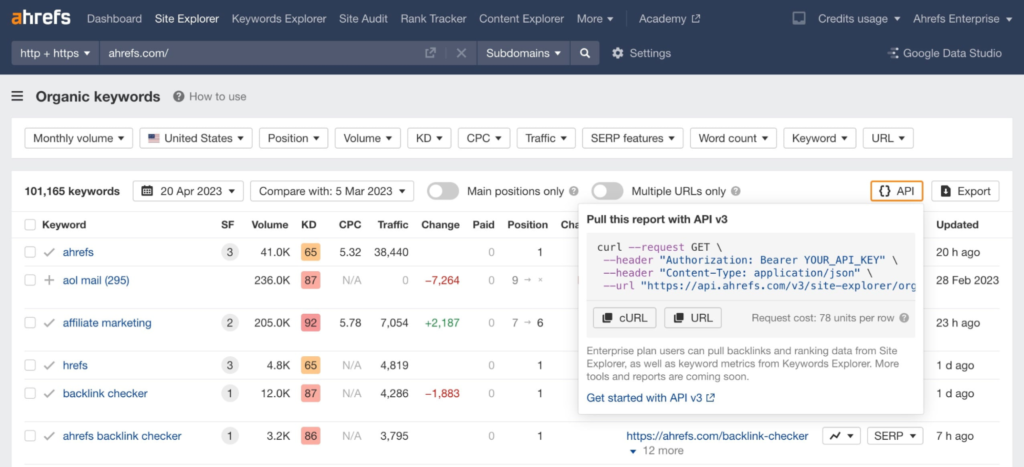
Ahrefs runs one of the largest web crawlers outside Google and that shows in its keyword data quality. The API covers keywords, backlinks, content, and SERP data at scale. It’s the reference standard for enterprise keyword analysis api work — when data accuracy matters more than cost, Ahrefs is usually the answer. The catch is that pricing is high and the API is billed per unit, which makes budget forecasting harder.
What Are the Key Features of Ahrefs API?
- Keyword volume, difficulty, clicks, and return rate data
- SERP overview per keyword including featured snippet detection
- Parent topic clustering — groups keywords by SERP overlap
- Keyword suggestions via ‘also rank for’, ‘questions’, and ‘related terms’ endpoints
- Backlink data per domain and URL through the same API key
- Content gap analysis accessible programmatically
- Historical SERP position data for trend analysis
- API v3 with clear endpoint documentation and SDKs for Python and JavaScript
What Are the Pros and Cons of Ahrefs API?
Pros:
- Best raw keyword database quality in the industry for most markets
- Clicks data provides conversion context that pure volume metrics miss
- Reliable seo keyword research api output — data matches what you see in the UI
- SERP history per keyword is deep and consistent
Cons:
- Unit-based billing makes cost unpredictable at high query volumes
- Enterprise pricing starts at $500+/month and climbs fast
- No free tier; testing requires a paid subscription
- Overkill for straightforward keyword suggestion api workflows where cost-per-query matters
What Is the Pricing of Ahrefs API?
- Lite Plan ($129/month): 5 projects, 6 months historical data, 750 tracked keywords, 5 tracked prompts, 100k crawl credits, 1,000 credits per user, 1 user (+2 at $40/mo), core tools (Site Explorer, Keywords Explorer, Rank Tracker, Site Audit, Competitive Analysis, API & MCP access, reports, dashboards)
- Standard Plan ($249/month): 20 projects, 2 years historical data, 2,000 tracked keywords, 10 tracked prompts, 500k crawl credits, unlimited credits per user, 1 user (+5 at $60/mo), all Lite features plus Content Explorer, batch analysis, SERP comparison, keyword clusters, AI suggestions, deeper analytics & reporting
- Advanced Plan ($449/month): 50 projects, 5 years historical data, 5,000 tracked keywords, 20 tracked prompts, 1.5M crawl credits, unlimited credits per user, 1 user (+10 at $80/mo), all Standard features plus Looker Studio integration, advanced site audit options, segmentation, and extended data insights
- Enterprise Plan ($1,499/month): all Advanced features plus unlimited API access, SSO & enterprise-grade security, access management & audit logs, unlimited historical data, custom limits & exports, and forecasting & trend analysis (annual commitment required)
Best Use Cases of Ahrefs API
- Enterprise SEO teams building internal tools where data accuracy is non-negotiable
- Research products that need the broadest possible keyword index coverage
- Backlink-plus-keyword workflows that can justify the combined API cost
- E-commerce platforms with large catalogs needing accurate search volume at scale
4. Semrush API
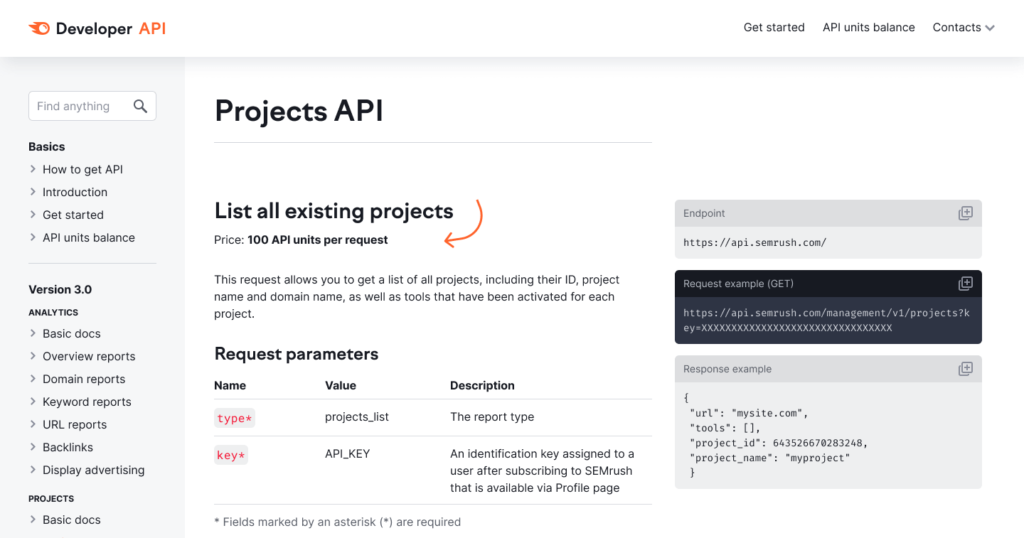
Semrush built its business on keyword and competitive intelligence, and the API reflects that. It’s one of the most data-rich seo keywords api options available, covering everything from keyword volume and intent to SERP features, cannibalization signals, and position tracking. The API documentation is the most thorough of any tool in this list. The per-unit billing model is the main friction point.
What Are the Key Features of Semrush API?
- Keyword overview, volume, intent classification, and difficulty
- Keyword magic tool accessible programmatically for large-scale keyword suggestion api requests
- Domain vs domain keyword gap analysis
- Organic and paid position tracking via API
- SERP feature detection including knowledge panels, carousels, and featured snippets
- Keyword clustering and topic research endpoints
- Trend data and seasonality signals per keyword
- Comprehensive keyword research tools api coverage across 140+ geo-databases
What Are the Pros and Cons of Semrush API?
Pros:
- Most complete keyword intent data among all tools reviewed
- Best geographic coverage — 140+ country and regional databases
- API documentation is detailed, with request/response examples for every endpoint
- Strong keyword analysis api depth including CPC trends and SERP feature history
Cons:
- API units are separate from plan credits and can be expensive at scale
- Base plan at $139.95/month does not include generous API access by default
- Can require significant setup work to normalize data across different API modules
- Less cost-effective than SE Ranking for teams that primarily need volume and difficulty data
What Is the Pricing of Semrush API?
- Pro plan at $139.95/month; API access requires purchasing additional units
- Guru plan at $249.95/month; broader limits but API units still consumed separately
- Business plan at $499.95/month includes more units and priority API access
- API units priced per 1,000 lines returned; costs vary by endpoint
Best Use Cases of Semrush API
- Full-service SEO agencies that need keyword data alongside competitor, backlink, and PPC data from a single API key
- International SEO campaigns requiring reliable data across multiple regional databases
- Teams building keyword intent classification into their content workflows
- Enterprise in-house SEO teams with budget for premium data infrastructure
5. Keywordtool.io API
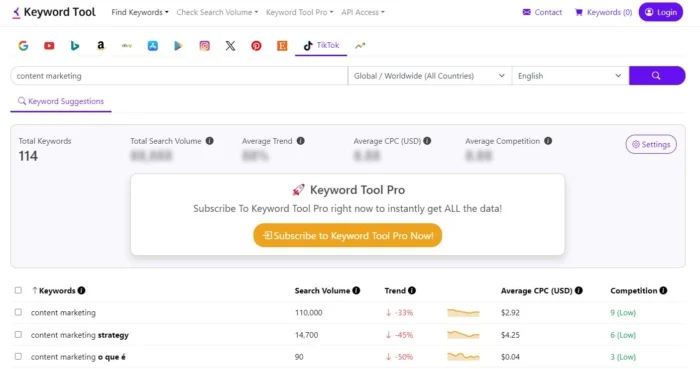
Keywordtool.io is a specialized keyword suggestion tool api built on top of autocomplete data from Google, YouTube, Bing, Amazon, Instagram, and App Store. It’s narrower in scope than the other tools here — no backlinks, no rank tracking — but for long-tail keyword mining at scale, it does the job well. The api keyword tool focuses on generating keyword variants from a seed term, which makes it useful for content expansion and e-commerce catalog work.
What Are the Key Features of Keywordtool.io API?
- Keyword suggestions from Google, YouTube, Bing, Amazon, Instagram, and App Store autocomplete
- Long-tail variant generation from a single seed keyword
- Question-based keyword extraction for FAQ and featured snippet targeting
- Search volume and CPC data available on paid tiers
- Multiple language and country combinations supported per request
- Batch keyword processing available on higher-tier plans
What Are the Pros and Cons of Keywordtool.io API?
Pros:
- Excellent for generating large long-tail keyword sets quickly
- Multi-platform coverage (Amazon, YouTube, App Store) not matched by most keyword tools api options
- Straightforward to implement — clean REST endpoint with minimal configuration
Cons:
- No keyword difficulty score in the API output
- No competitor data or SERP analysis
- Volume data requires the most expensive tier
- Not suitable as a standalone seo keyword research api for full-cycle SEO campaigns
What Is the Pricing of Keywordtool.io API?
- Starter Plan ($88/month): 50 requests/day, 50,000 keywords/day search volume data, 12 months historical data, web interface + MCP + API access, all 15 platforms, CPC & competition data, device breakdown, 30-day money-back guarantee
- Growth Plan ($188/month): 100 requests/day, 100,000 keywords/day search volume data, 24 months historical data, web interface + MCP + API access, all 15 platforms, CPC & competition data, device breakdown, 30-day money-back guarantee
- Scale Plan ($388/month): 200 requests/day, 200,000 keywords/day search volume data, 48 months historical data, web interface + MCP + API access, all 15 platforms, CPC & competition data, device breakdown, 30-day money-back guarantee
- Agency Plan ($788/month): 400 requests/day, 400,000 keywords/day search volume data, 48 months historical data, web interface + MCP + API access, all 15 platforms, CPC & competition data, device breakdown, 30-day money-back guarantee
Best Use Cases of Keywordtool.io API
- E-commerce teams mining Amazon autocomplete for product keyword variants
- YouTube SEO workflows that need video keyword suggestion api data at scale
- App Store Optimization projects requiring mobile-specific keyword sets
- Content teams building FAQ-based keyword clusters from question extraction
Conclusion
For most SERM professionals, SE Ranking API hits the best balance of data quality, endpoint coverage, and cost at scale. It covers the full keyword research tools api workflow — from discovery and analysis to tracking — without the unit-based billing surprises of Ahrefs and Semrush.
Ahrefs wins on raw data accuracy if budget is not the deciding factor. Semrush wins on geographic breadth and intent classification. SpyFu is the right call for US-focused competitive and PPC research. Keywordtool.io handles long-tail and multi-platform keyword suggestion api work better than any other tool here but shouldn’t be your only data source.
Pick based on your actual query volume, the markets you operate in, and how your billing model handles variable API consumption. The data quality differences between these platforms matter less than getting the cost-per-query calculation right for your use case.
FAQ
1. What is the best keyword research API for agency use?
SE Ranking API is the top choice for most agencies. It covers keyword volume, difficulty, suggestions, and competitor data through a single subscription, and it scales without per-unit billing complexity.
2. Is there a free keyword research API?
SE Ranking offers a 14-day free trial and 100,000 credits. Most other platforms on this list — Ahrefs, Semrush, SpyFu, Keywordtool.io — require a paid plan for API access.
3. How does the Ahrefs API differ from Semrush’s?
Ahrefs has a larger keyword database and stronger backlink data. Semrush has better keyword intent classification and wider geographic coverage. Both use unit-based billing; Ahrefs is generally more expensive for high-volume api keyword research workflows.
4. Can I use a keyword suggestion tool API for e-commerce keyword research?
Yes. Keywordtool.io works well for Amazon autocomplete mining. SE Ranking and Semrush cover e-commerce keyword analysis api needs more broadly, including competitor gap analysis and search trend data.
5. What data does a typical keyword analysis API return?
Standard responses from most seo keyword research api platforms include search volume, keyword difficulty, CPC, trend data, and related keyword suggestions. Some platforms also return SERP feature data, click rates, and intent classification.
6. Is SpyFu API worth it for international SEO projects?
No. SpyFu’s data quality is strongest in the US market. For international campaigns, SE Ranking is better choice for keyword research tools api access..
7. What is the easiest keyword tools API to integrate?
Keywordtool.io and SE Ranking have the simplest REST implementations. Semrush and Ahrefs have more thorough documentation but also more complex multi-module structures to navigate during integration.
8. Can I use these APIs to build a white-label SEO product?
SE Ranking explicitly supports white-label use cases. Semrush allows API use in third-party products under its terms of service. Ahrefs restricts reselling of API data; check their current terms before building on it. Keywordtool.io and SpyFu have standard API terms that limit redistribution.
9. Which SEO keyword research API is best for SaaS products?
SE Ranking API is consistently the best fit for SaaS products that need to embed keyword data — the combination of plan-based pricing, clean REST endpoints, and breadth of data makes it the most predictable choice. For products where keyword difficulty data specifically needs to match Ahrefs-quality benchmarks, Ahrefs Enterprise is the alternative despite the cost.