Generative Engine Optimization: How to Make Your Content Visible Inside AI Answers


Search is shifting from a list of links to a synthesized answer, and the scale of the shift is now quantified. Gartner forecasts that traditional search engine volume will drop 25% by 2026, with search marketing losing share to AI chatbots and other virtual agents that act as “substitute answer engines.” When someone asks a question in an AI assistant or an AI-enhanced result, they often get a single composed response and never click through. Generative engine optimization is the practice of making sure your content is the material those systems select, summarize, and cite, not just something that ranks on a page fewer people scroll to.
Table of Contents
If you already do SEO, GEO is not a replacement. It is the layer that makes your existing work legible to generative systems. This guide explains what changes, why it matters, and how to build a GEO program on top of the SEO foundations you already have.
What Generative Engine Optimization Is
Classic SEO has one goal: get a page to rank for a query. Generative engine optimization works one step further down the line. When a user asks an AI assistant a question, the system does not hand back a list of links. It pulls material from sources it considers reliable, extracts the facts it trusts, and writes a single answer. GEO is the work of making sure your brand is one of those trusted sources, and that it gets named in the answer. In practice, that means two things: structuring your content so a model can easily parse and quote it, and keeping the signals about your brand consistent across the web so the model reaches for you with confidence. These systems run on generative artificial intelligence, which is why the rules differ from those of traditional search.

Why AI Search Engine Optimization Now Matters
User behavior has already shifted. Instead of typing “best CRM,” people now ask “which CRM integrates with legacy accounting tools for a mid-sized logistics firm,” and they expect a direct answer rather than a page of links to sift through. This is what makes ai search engine optimization a separate problem from ranking in classic results. The answer a model gives is not just a reordered list of the top-ranking pages. Because large language models weight sources differently and favor certain content structures, a brand can hold the number one spot on a results page and still be left out of the generated answer entirely, or described inaccurately within it. That gap matters more every quarter, because the forecast 25% drop in traditional search volume is moving exactly to these surfaces. Ground you used to own is quietly shifting to a place most brands are not yet optimizing for.
How Generative Engines Choose Sources
A model does not just reorder the top search results and read them back. It decides which sources to trust, and a few factors drive that decision:
- Relevance and specificity. How closely the content matches the exact question and the intent behind it, not just the broad topic.
- Source authority. Whether the domain is known for strong editorial standards, which earns it extra weight.
- Citable structure. Clear, self-contained passages the model can lift cleanly, without having to stitch the point together from scattered sentences.
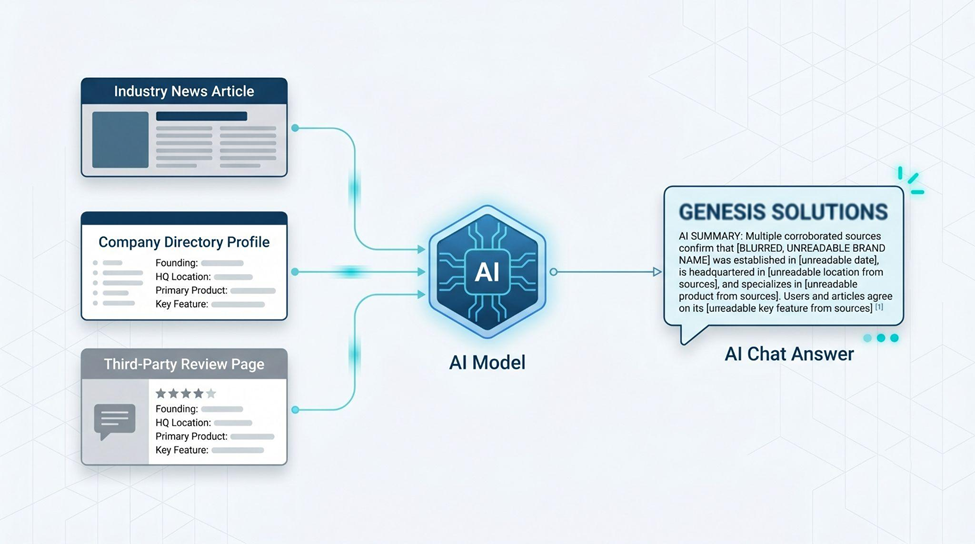
- Consistency across sources. When the same facts about a brand appear the same way everywhere the model looks, it is far less likely to hedge or guess.
The Building Blocks of a GEO Program
Entity consistency. Make sure the core facts about your brand, what it is, what it does, and who it serves, are stated identically across your site, your profiles, and the reference sources models lean on. Contradictions are what push systems toward vague or outdated answers.
Answer-first, citable content. Lead sections with a tight 40 to 60 word summary that directly answers the implied question, then expand. Models reward content they can quote without reassembling it, and so do the humans skimming an AI overview.
Third-party authority. A single self-published claim carries little weight. Independent coverage across credible domains gives a model multiple corroborating signals, far more persuasive to a retrieval system than one well-optimized page on your own site.
Multilingual coverage. If you operate in more than one market, your entity needs to be consistent in each language, or a model may describe you accurately in English and inaccurately everywhere else.
A Practical GEO Workflow
You can start without any new tooling. The work breaks into five steps:
- Audit current AI answers. Ask the major assistants and AI search interfaces about your brand, your category, and your key topics. Note what they say, the sentiment, and which sources they seem to rely on.
- Fix the entity data first. Correcting inconsistencies across your profiles and structured data is the cheapest, highest-leverage move, so it comes before anything else.
- Restructure your best pages. Add answer-first summaries and self-contained facts so a model can quote them without reassembling the point.
- Build corroboration. Earn accurate, structured coverage on credible third-party platforms, since models trust a claim more when several independent sources agree.
- Monitor and correct on a schedule. Catch new inaccuracies and fix them before they harden into the default answer.
Common GEO Mistakes to Avoid
A few habits quietly undermine otherwise solid programs. The most common is treating GEO as a one-off project, when AI answers keep shifting as models and sources update, so a single optimization pass goes stale quickly. Another is optimizing only your own pages, which leaves a retrieval system nothing independent to corroborate, even though independent agreement is exactly what it trusts most. Burying the key point deep in an article creates a similar problem, since a model favors content it can lift cleanly and rarely makes it to paragraph six. And ignoring sentiment is its own trap, because being named in an answer that frames you poorly can be worse than not appearing at all.
How to Measure GEO Progress
Because the surface is conversational, measurement looks different from rank tracking. Rather than positions, you are watching how a model talks about you: how often your brand is named in answers to relevant prompts, whether the description is accurate and favorable, which sources the model appears to cite, and how consistent the answer stays from one assistant to the next. Tracking those signals over time turns a vague sense that “AI says good things about us” into something you can actually manage, and it shows you where the next round of generative engine optimization work should go.
GEO and SEO Work Together
Generative engine optimization does not retire your SEO playbook; it extends it. Strong technical health, authoritative content, and credible external signals all serve both surfaces at once, so the underlying work overlaps more than it competes. The difference is the goal. SEO earns the click, while GEO earns the mention inside the answer that increasingly arrives before any click happens. As traditional search volume contracts, the brands that win the next phase will be the ones that stop treating these as two projects and run them as one.
Metadata
- SEO Title: Generative Engine Optimization: How to Be Visible in AI Answers
- Meta Description: A practitioner’s guide to generative engine optimization: how generative engines choose sources, why search volume is shifting, and a workflow to get cited in AI answers.
- Slug: generative-engine-optimization-guide
- Primary Keyword: generative engine optimization
- Secondary Keywords: ai search engine optimization, GEO, AI overviews, entity consistency, citable content