8 Best Proxies for Rank Tracking in 2026

Search rankings change by location, device, language, personalization signals, and SERP layout, so rank tracking needs clean access to the same Google results that target users see. According to Statcounter Global Stats, Google held 85.17% of the U.S. search market across desktop, mobile, and tablet in April 2026. Such dominance makes rank tracking a core SEO task, where inaccurate SERP access can distort traffic forecasts, competitor analysis, and local visibility reports.
Accurate rank data depends on stable access to search results at scale. Agencies, affiliate sites, marketplaces, SaaS companies, and local businesses often track thousands of keyword and location combinations, which creates a technical access challenge during scheduled checks. A well-configured proxy setup helps rank trackers reach the right SERP environment consistently, so reports reflect real search performance instead of failed checks, wrong regions, or missing SERP features.
Why Do Rank Trackers Need Proxies?
Large keyword scans need clean access to Google results from the right location, device context, and IP environment. A single IP source gives SEO tools a narrow search view and quickly creates access problems during repeated checks. A proxy network helps tracking systems reach different SERP environments more consistently and keeps ranking reports closer to real user search conditions.
Location-Based SERPs
Geography shapes search results long before a user clicks anything. A query for legal services, clinics, hotels, storage units, or restaurants can produce different rankings across states, cities, and neighborhoods. Rank tracking proxies help SEO tools check results from the target area, so reports reflect the market that matters for each campaign.
Automated Rank Checks
Modern SEO tracking runs on schedules, keyword groups, competitors, devices, and locations. A single campaign can include branded terms, product keywords, competitor names, local phrases, and long-tail queries. Proxies spread those checks across many IPs, which keeps larger tracking jobs steadier during daily, weekly, or hourly scans.
Fewer Blocks and CAPTCHAs
Search engines react quickly to repeated requests from one narrow access point. A rank tracker that sends too many checks through one IP can face rate limits, CAPTCHA pages, empty results, or inconsistent responses. Rotating proxies reduce pressure on each address and help tools collect more complete SERP data.
What Can Go Wrong With Poor Rank Tracking Access?
Weak access turns technical errors into bad SEO decisions. Real SERP movement should guide ranking reports, while broken checks, mismatched locations, and missing features create false signals.
- Wrong Local Results: Reports may reflect another country, city, or search environment.
- Failed Keyword Checks: Rate limits can interrupt scheduled tracking and create missing data.
- Missing SERP Features: Maps, snippets, shopping blocks, and local packs may disappear from reports.
- Unstable Trends: Access errors can look like ranking drops during reporting.
- Weak Scaling: Large keyword sets can overload one IP source during peak checks.
Which Proxy Type Works Best for SERP Tracking?
Each setup fits a different SEO workflow. The best choice depends on target locations, tracking volume, device focus, and the sensitivity of the search environment.
Residential Proxies
Consumer-grade IPs give rank trackers a more natural access pattern for localized search checks. These connections help collect results from countries, cities, and regional environments where rankings can shift heavily. SEO teams often use this option when accuracy matters more than raw request speed.
Mobile Proxies
Carrier-based access gives a clearer view of search behavior tied to smartphones and mobile networks. Phone searches often trigger different layouts, map packs, app results, and local intent signals. This setup works best when reports need to reflect mobile-first SERP conditions.
Datacenter Proxies
Fast server-based IPs fit structured tracking jobs with predictable request patterns. This option can support high-volume checks, quick response times, and simple scaling for less sensitive workflows. Technical SEO teams often use it for controlled testing, broad monitoring, and speed-focused data collection.
How Did We Evaluate the Best Proxies?
Provider quality depends on practical SEO performance. Strong rank tracking proxies need stable sessions, accurate targeting, reliable rotation, and smooth compatibility with common tracking systems.
- SERP Reliability: The setup must return complete search results with fewer failed checks.
- Location Accuracy: Targeting must match the country, city, or region used in the SEO campaign.
- Rotation Control: The network must support scheduled rotation and sticky sessions for different tracking patterns.
- SEO Tool Compatibility: The proxy must work with rank trackers, SERP scrapers, browser automation, and custom scripts.
- Pricing Fit: Costs must match keyword volume, bandwidth needs, location depth, and daily tracking frequency.
Which Rank Tracking Proxies Stand Out in 2026?
Rank tracking workflows depend on stable proxy infrastructure, accurate geo-targeting, and tools that support large-scale SERP collection. Different providers focus on different proxy networks, scraping systems, and session controls, so SEO teams often compare them by available proxy types, automation support, and search data capabilities.
| Proxy service | Available products | Best tools for Rank Tracking | Trustpilot rating |
| 1. Live Proxies | Rotating residential proxies, rotating mobile proxies | API access, sticky sessions up to 24 hours, IP whitelisting, unlimited threads | 4.3 |
| 2. Infatica | Residential proxies, mobile proxies, datacenter proxies, ISP proxies | SERP Scraper API, Google Search Scraper API, Web Scraper API | 3.3 |
| 3. IPRoyal | Residential proxies, ISP proxies, mobile proxies, datacenter proxies | Web Unblocker, Proxy Tester, Online Proxy Checker, API | N/A |
| 4. Rayobyte | Residential proxies, ISP proxies, datacenter proxies | Web Scraping API, Proxy Pilot, Proxy API | 4.2 |
| 5. DataImpulse | Residential proxies, mobile proxies, datacenter proxies, premium residential proxies | API for Users, API for Resellers | 3.7 |
| 6. ProxyEmpire | Residential proxies, mobile proxies, datacenter proxies | Proxy Checker, integrations, proxy API | 4.4 |
| 7. Decodo | Residential proxies, mobile proxies, ISP proxies, datacenter proxies | SERP Scraping API, Web Scraping API, Site Unblocker, Public API | 4.4 |
| 8. Oxylabs | Residential proxies, mobile proxies, datacenter proxies, ISP proxies | SERP Scraper API, Web Scraper API, Web Unblocker | 3.8 |
1. Live Proxies
Live Proxies fits rank tracking workflows that need consumer-grade proxy servers, controlled rotation, and clean access from different search environments. The network includes millions of IPs across 55+ countries, with strong coverage for the US, UK, and Canada. Sticky sessions can run up to 24 hours, which helps SEO teams keep stable access during long keyword scans, account-based checks, and multi-step SERP collection.
Each account can receive its own assigned IP set, so rank tracking activity does not mix with unrelated users on the same pool. For larger business setups, IP separation can also follow target logic, which means one customer’s allocation for a specific destination does not overlap with another customer working on the same destination type. A rotating residential proxy setup works well here when SEO teams need regional SERP views, controlled session behavior, and cleaner repeated access to search results.
Key Strengths
- Free Proxy Tester: The desktop tool checks proxy performance, reliability, speed, country, ISP, and response behavior before larger SEO workflows begin.
- Unlimited Threads: High-concurrency support allows parallel tasks during heavy keyword monitoring and broader SERP collection.
- Protocol Flexibility: HTTP and SOCKS5 support gives technical teams more setup options for browsers, scripts, and automation environments.
- 24/7 Support: Round-the-clock assistance helps with setup, troubleshooting, and connection issues during active tracking work.
Why Live Proxies Fits Rank Tracking
Local SEO monitoring, competitor visibility checks, scheduled keyword scans, and SERP scraping benefit from this setup when projects need stable sessions and location diversity. The strongest fit comes from multi-region campaigns where access quality, target-specific IP separation, and rotation control directly affect ranking data quality.
2. Infatica
Infatica works for rank tracking teams that need proxy coverage and scraping products in one setup. The provider lists 40M+ ethically sourced proxies across 195 countries, which gives SEO teams enough geographic depth for multi-market SERP checks. Its proxy line includes residential, mobile, datacenter, and ISP proxies, while its scraping products cover SERP extraction, Google data, web pages, YouTube data, and AI search data.
SERP-focused collection is the strongest rank tracking angle here because Infatica’s SERP Scraper API extracts keyword suggestions, questions, and links from Google and Bing. Its Google Scraper API supports structured Google data collection at scale, including SERP, ads, and shopping data for analytics and research workflows. The Google product lists up to 99.9% request reliability and structured JSON output, which matters when SEO teams need consistent ranking datasets rather than screenshots or manual exports.
Key Strengths
- SERP Scraper API: Extracts search data from Google and Bing for keyword research, competitor monitoring, and SEO analysis.
- Google Scraper API: Collects structured SERP, ads, and shopping data for large-scale research projects.
- Scraper API Suite: Includes web scraping, search scraping, YouTube data collection, and custom scraping as a service.
- ISP Proxy Option: Uses ISP-hosted addresses for professional web scraping and data collection tasks that need dedicated IP behavior.
Why Infatica Fits Rank Tracking
Enterprise SEO teams can use this provider for search result extraction, regional ranking checks, keyword discovery, ad monitoring, and shopping SERP analysis. The strongest fit comes from workflows that need proxy infrastructure, together with structured search data delivery through dedicated scraping APIs.
3. IPRoyal
IPRoyal gives rank tracking teams access to residential, ISP, mobile, and datacenter proxy categories in one product stack. Its residential proxy pool reaches 32M+ IPs, while ISP proxies list 500K+ unique IPs for long-session reliability and automation-heavy projects. Residential proxies start from $1.75/GB, and the provider directly names SEO monitoring and geo-targeted research as core use cases for the residential network.
Residential sourcing adds a practical quality signal for SEO workflows because IPRoyal uses Pawns.app and established IP service provider partnerships to add user-shared endpoints to the network. This approach gives the company more control over network consistency, connection stability, and scale. For testing, IPRoyal also provides an online proxy checker that checks HTTP/HTTPS and SOCKS5 proxies, verifies working status, and processes full proxy lists in one run.
Key Strengths
- Proxy Tester: A desktop testing tool helps validate proxy performance before larger tracking jobs.
- Online Proxy Checker: Checks HTTP/HTTPS and SOCKS5 proxies and returns working status for uploaded proxy lists.
- Residential Pool Size: 32M+ IP pool supports geo-targeted research and SEO monitoring at scale.
- Direct Sourcing Model: Pawns.app and partner sourcing help maintain stronger control over network supply.
Why IPRoyal Fits Rank Tracking
SEO teams can use IPRoyal for local keyword tracking, competitor SERP checks, ad verification, and long-session workflows that need ISP-grade stability. The strongest fit comes from projects that combine broad residential coverage with pre-run proxy validation.
4. Rayobyte
Rayobyte combines proxy networks with scraping automation for teams that need raw proxy access and managed extraction options. Its residential product lists 36M+ real residential IPs, while its proxy stack includes residential, ISP, datacenter, and rotating ISP options. The datacenter line supports dedicated, semi-dedicated, and rotating datacenter proxy types, which gives technical SEO teams several ways to match access style with budget, request volume, and target sensitivity.
Proxy Pilot gives Rayobyte a useful rank tracking angle because the tool helps manage proxy behavior during scraping workflows. Official Rayobyte material describes Proxy Pilot as built into residential proxies, able to detect whether a proxy has hit a block or a technical issue, and capable of routing traffic across countries for geo-targeted collection. The Web Scraping API also supports JavaScript rendering, browser management, proxy rotation, advanced fingerprinting, and 5,000 free scrapes per month for new users.
Key Strengths
- Proxy Pilot: Automates proxy handling and helps distinguish blocks from technical failures during data collection.
- Web Scraping API: Handles proxies, browsers, rate limits, and HTML retrieval through a single scraping product.
- ISP Proxy Network: Provides static and rotating ISP options with unlimited bandwidth and zero throttling claims.
- Chrome Proxy Extension: Supports residential, ISP, mobile, and datacenter proxies with HTTP(S) and SOCKS switching.
Why Rayobyte Fits Rank Tracking
Technical SEO teams can use Rayobyte for scripted SERP checks, broad data collection, competitor monitoring, and geo-targeted research where proxy management needs automation. The strongest fit comes from workflows that require a mix of proxy types, scraping API support, and automated handling of blocked or unstable requests.
5. DataImpulse
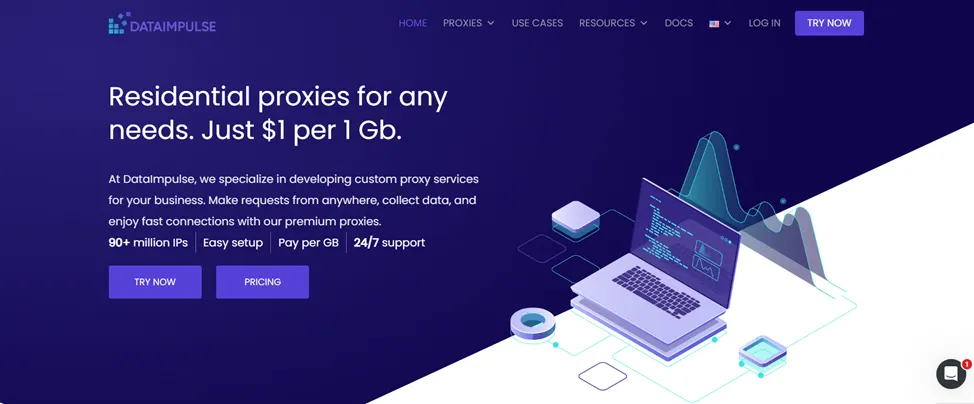
DataImpulse offers residential, mobile, datacenter, and premium residential proxies for teams that need a broad proxy inventory at a low entry cost. The provider lists 90M+ IPs, coverage across 195 countries, and pricing from $1 per GB, which can suit high-volume SEO monitoring when budget control matters. Its stated use cases include SERP tracking, web scraping, ad verification, price intelligence, competitor analysis, and market monitoring.
Targeting depth is useful for rank tracking because DataImpulse supports country, city, ZIP code, and ASN targeting in localized monitoring workflows. Session control also has a documented session ID option that connects to a specific IP address for an average of 30 minutes. API access is available for managing proxy usage, controlling sessions, integrating with tools, and automating tasks, which gives technical teams a programmatic path for scheduled rank checks.
Key Strengths
- Advanced Targeting: Country, city, ZIP code, and ASN filters help align proxy access with local search environments.
- Session ID Control: The sessid parameter connects to one IP for an average of 30 minutes during a task.
- API Access: Programmatic controls support proxy usage management, session handling, integrations, and automation.
- Premium Residential Pool: Selected residential IPs focus on better success rates, uptime, targeting precision, and stable connectivity.
Why DataImpulse Fits Rank Tracking
SEO teams can use DataImpulse for localized keyword monitoring, price-linked SERP research, competitor checks, and recurring search data collection across many regions. The strongest fit comes from projects that need large IP reach, granular targeting, and simple traffic-based scaling.
6. ProxyEmpire
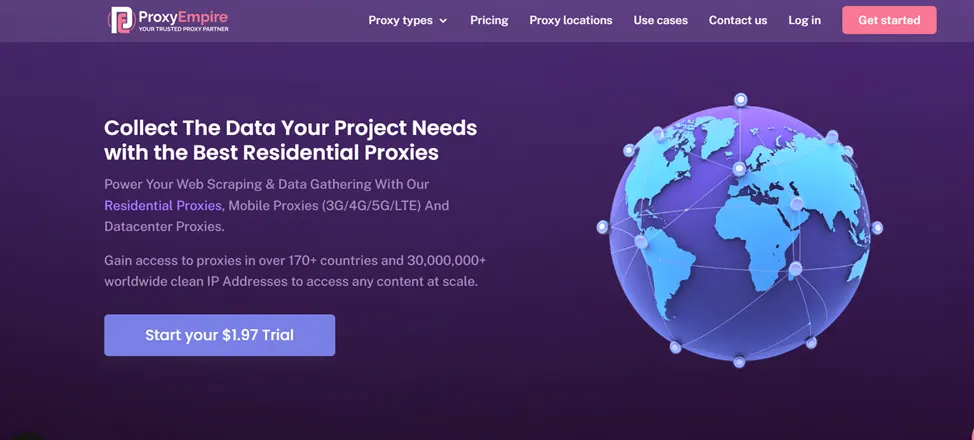
ProxyEmpire serves rank tracking teams through residential, mobile, and datacenter proxies, with additional product options for rotating residential, rotating mobile, dedicated mobile, static residential, and rotating datacenter access. The network lists 30M+ clean IPs, 170+ countries, 99.9% uptime, and 24/7 support. Its location inventory shows country, regional, and city targeting, with examples such as 2,282,429 clean IPs in the United States, 174,025 in France, 152,628 in Germany, and 30,676 in the Netherlands.
ProxyEmpire has several tool-level details relevant to search workflows. Its Proxy Checker tests proxy functionality and speed, then returns real-time status, connection time, country, and ISP for each proxy. The documentation also covers targeting options, concurrent sessions, rotation control, sticky sessions, bandwidth tracking, supported protocols, and blocked destinations, which matter for teams that need predictable configuration before running scheduled SERP checks.
Key Strengths
- Proxy Checker: Tests live proxy status, speed, country, ISP, and connection time before production use.
- Location Targeting: Country, regional, and city filters support localized collection across 170+ countries.
- Integration Ecosystem: Native anti-detect browser partnerships include Dolphin Anty, AdsPower, Multilogin, GoLogin, Kameleo, and OctoBrowser.
- Configuration Documentation: Setup guidance covers rotation frequency, sticky sessions, connection protocols, and thread usage.
Why ProxyEmpire Fits Rank Tracking
Agency and affiliate teams can use ProxyEmpire for city-level SERP checks, local competitor monitoring, automated browsing environments, and recurring search data collection. The strongest fit comes from workflows that need location filters, proxy testing, and browser-profile integrations.
7. Decodo
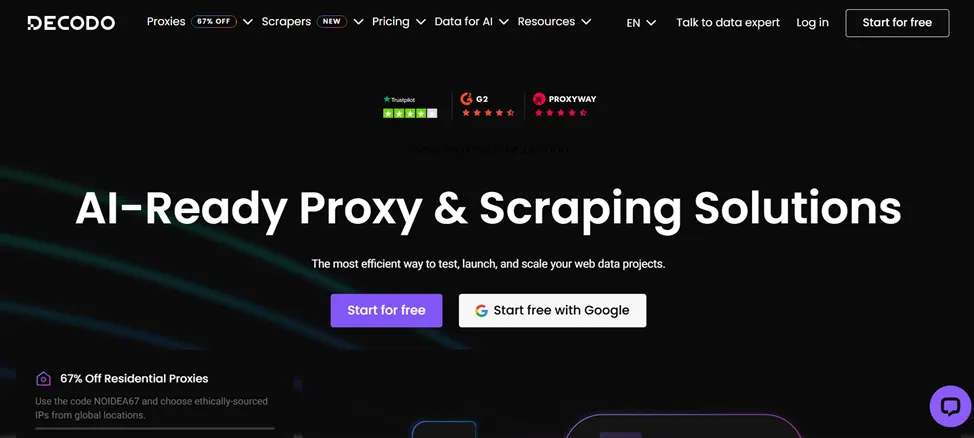
Decodo gives SEO teams a large proxy and scraping stack built around search data collection. Its scraping infrastructure combines 125M+ residential, mobile, ISP, and datacenter proxies with a web scraper and parser, while its Web Scraping API lists 99.99% uptime, 99.86% success rate, and an average response time under 0.6 seconds. The SERP Scraping API supports real-time search engine results and can return outputs in HTML, JSON, CSV, Markdown, PNG, XHR, or table format, depending on the target.
Google Search scraping is especially relevant for rank tracking because Decodo’s product extracts organic results, search ads, People Also Ask boxes, keyword rankings, SERP positions, local pack listings, related search suggestions, and autocomplete suggestions. The same product supports Python, Node.js, and cURL integration, which helps technical teams plug SERP collection into existing reporting pipelines. Decodo also describes its SERP Scraping API as a tool for SEO monitoring, local rankings, region-specific keyword performance, ad campaigns, snippets, and local packs.
Key Strengths
- SERP Scraping API: Collects real-time search results with geo-targeting and automated proxy management.
- Google Search Scraper: Extracts organic rankings, ads, People Also Ask data, local packs, and autocomplete suggestions.
- Web Scraping API: Supports JavaScript rendering, AI integrations, 100+ pre-built templates, and multiple output formats.
- Site Unblocker: Complements scraping workflows when anti-bot systems interfere with data collection.
Why Decodo Fits Rank Tracking
SEO teams can use Decodo for Google position monitoring, SERP feature extraction, paid search tracking, local pack visibility, and competitor research across markets. The strongest fit comes from teams that need structured SERP data, multiple output formats, and scraping infrastructure that reduces manual proxy handling.
8. Oxylabs
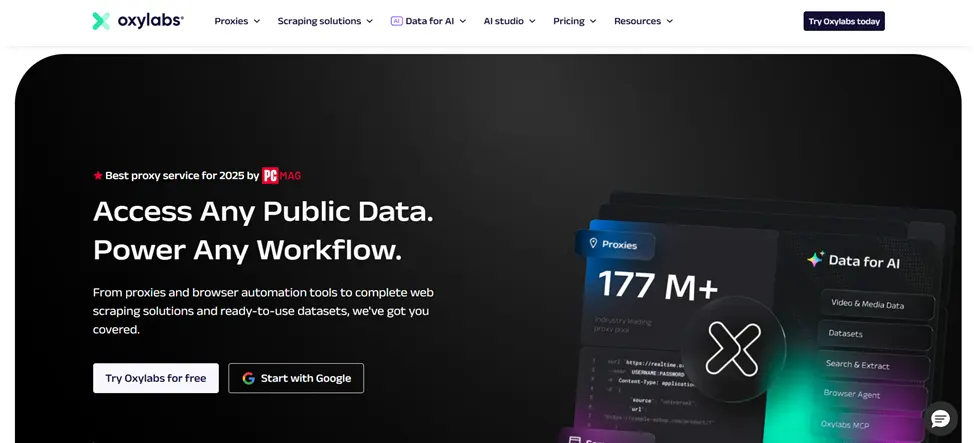
Oxylabs fits enterprise rank tracking projects that need proxies, scraper APIs, and unblocking infrastructure under one provider. Its SERP Scraper API gathers real-time search engine data for SEO analysis, market research, competitor tracking, keyword research, ranking analysis, advertising checks, and reputation monitoring. The product starts from $1.6 per 1,000 results and supports Google Search continuous scroll, which helps collect larger organic result sets without extra request parameters.
Oxylabs also provides Web Scraper API and Web Unblocker for broader search and web data workflows. Web Scraper API can gather SEO data from Google and Bing and retrieve LLM-generated responses from ChatGPT, Google AI Mode, and Perplexity, while Oxylabs proxies cover 195 countries for SERP monitoring systems. Web Unblocker adds AI-powered unblocking, proxy-like integration, JavaScript rendering, session control, and rate limits up to 50 requests per second on paid plans.
Key Strengths
- SERP Scraper API: Extracts search engine data for ranking analysis, keyword research, competitor monitoring, and advertising checks.
- Web Scraper API: Collects Google, Bing, and AI search platform data for SEO and GEO monitoring systems.
- Web Unblocker: Uses AI-powered unblocking, JavaScript rendering, and raw HTML output for difficult public web targets.
- Dedicated Datacenter Pool: Provides 2M+ dedicated IPs across 188 countries with 99.9% uptime and up to 100 concurrent sessions per IP under fair usage.
Why Oxylabs Fits Rank Tracking
Large SEO teams can use Oxylabs for SERP monitoring, Google data extraction, AI search tracking, competitor research, ad placement checks, and large-scale visibility reporting. The strongest fit comes from enterprise workflows that need scraper APIs, unblocking automation, high-volume infrastructure, and broad geographic coverage.
How to Choose a Proxy for Different Rank Tracking Setups?
Project structure should define the proxy choice before price or pool size. Local SEO campaigns, national keyword tracking, marketplace monitoring, and enterprise dashboards create different access patterns, so one setup rarely fits every workflow.
Local SEO Campaigns
City-level tracking needs precise location control because rankings can change across nearby areas. Clinics, law firms, restaurants, home services, hotels, and storage brands often need SERP checks tied to specific cities or regions. Residential proxies usually fit these workflows because they help rank trackers collect search results from more realistic local environments.
Large Keyword Portfolios
High-volume tracking needs stable rotation, enough IP capacity, and predictable session behavior. Agencies and affiliate teams often run thousands of checks across many sites, niches, and countries. Proxy setups for these projects need enough scale to keep scheduled scans complete during peak reporting windows.
Mobile-First Monitoring
Mobile SERPs can show different layouts, local packs, app results, and click paths. Brands that depend on phone searches need proxy access that reflects mobile search conditions more closely. Mobile proxies work well for campaigns where rankings, snippets, maps, and ad placements change by device context.
Which Mistakes Distort Rank Tracking Data?
Bad setup choices can damage ranking reports even when the proxy provider works correctly. Most tracking problems come from mismatched locations, unstable sessions, weak testing, or overloading one access pattern.
- Ignoring Device Context: Desktop and mobile results can differ, so one device view may hide ranking changes in another SERP layout.
- Using Broad Locations: Country-level checks may miss city-level movement in local packs, maps, and near-me searches.
- Skipping Pre-Run Tests: Untested proxies can create failed requests, wrong IP locations, and incomplete reports during scheduled scans.
- Overloading One Session Type: Constant rotation can disrupt multi-step checks, while long sessions can reduce freshness during broad keyword scans.
- Tracking Too Many Markets Together: Mixed regions inside one report can blur local visibility trends and make competitor analysis less useful.
Conclusion
Rank tracking accuracy depends on location quality, session control, request stability, and the ability to collect SERP data without interruptions. Different providers focus on different strengths, including large residential pools, scraper APIs, mobile coverage, proxy testing, or enterprise-scale automation support.
SEO teams usually match proxy infrastructure to the type of tracking workflow they run most often. Local SEO campaigns often need stronger geo-targeting, large affiliate projects rely on broader IP scale, and enterprise monitoring systems depend on structured SERP extraction with stable automated access.