When to Switch Your Data Analytics Service Provider

Most companies stick with an underperforming analytics partner far longer than they should. The contract’s in place, switching feels disruptive and there’s always a hope that the next deliverable will turn things around. Meanwhile the reports stay unreliable and the strategic work never quite happens. If you suspect your data analytics service provider isn’t earning their keep, this guide will help you decide whether it’s time to move on and how to do it without repeating the mistakes that got you here.
Business leader evaluating whether to switch their data analytics service provider
Caption: A decision-maker weighing the warning signs that signal it’s time to change analytics partners.
The signs your provider isn’t delivering
A few patterns reliably mark a relationship that’s gone wrong:
You don’t trust the numbers. The clearest signal. If you find yourself double-checking the reports your provider delivers or quietly maintaining your own spreadsheets alongside them, the engagement has failed at its most basic job.
Everything is a dashboard, nothing is a decision. A good provider connects their work to outcomes – faster reporting, better forecasts, decisions that improve. If all you get is more charts with no measurable impact, you’re paying for decoration.
Simple requests take forever. When a small change to a report turns into a multi-week project, it usually means the underlying setup is brittle or poorly understood, even by the people who built it.
They never raise the foundation. If your provider only ever talks about the visible layer and never about data quality, integration or governance, they’re either ignoring the foundation or don’t understand it. Both are problems and they’re common ones. Harvard Business Review reports that only 3% of companies’ data meets basic quality standards, so a provider who never mentions the foundation is almost certainly building on cracked ground.
You’ve outgrown them. Sometimes nobody did anything wrong. A provider who was perfect for basic reporting may simply lack the depth for the predictive analytics and integration work you now need.
One of these might be fixable with a frank conversation. Several together usually mean the fit is wrong.
Try to fix it first
Switching is disruptive, so it’s worth one honest attempt to repair the relationship before you walk. Lay out specifically where the work falls short, tie it to outcomes you expected and ask how they’d address it. A good provider responds with a concrete plan. A struggling one gets defensive or vague.
That conversation is also a useful test. How a provider handles direct criticism tells you a lot about whether the relationship can recover. If they take it seriously and propose real changes, give them a defined window to deliver. If they brush it off, you have your answer.
What switching actually involves
The fear of switching is usually bigger than the reality, but there’s real work involved and knowing it helps you plan:
- Knowledge transfer. Whoever delivers your data analytics services holds context about your data and setup. Getting that documented and handed over matters and it’s smoother when contracts anticipate it.
- Access and ownership. Make sure you own your data, your accounts and ideally your dashboards and pipelines. If your provider built everything in their own environment, untangling that is the hard part – a lesson for the next contract.
- Continuity. You need reporting to keep running during the transition. A good incoming provider plans for overlap rather than a hard cutover.
This is exactly why ownership terms matter when you sign. The companies that get stuck are the ones whose entire analytics setup lives inside a provider’s walled garden. Insist on owning your foundation and switching becomes far less painful.
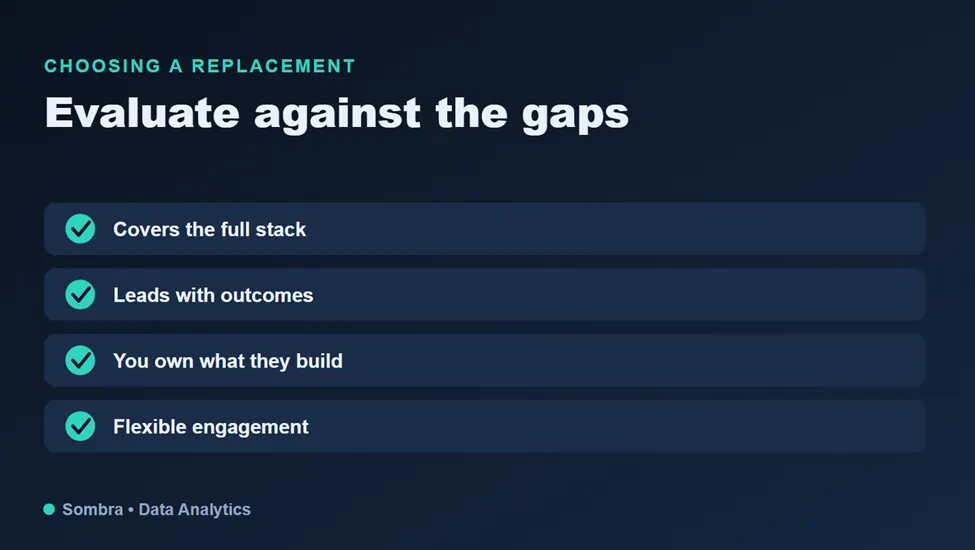
Checklist for choosing a replacement data analytics service provider
Caption: Evaluating a new analytics partner against the specific gaps that sank the last engagement.
Choosing a replacement that lasts
The goal isn’t just a new data analytics company. Evaluate candidates against the failures you just lived through:
- Do they cover the full stack? A partner who handles data integration, quality and governance alongside reporting and advanced analytics won’t leave the foundation gaps that sank the last engagement. An end-to-end data analytics service provider is harder for problems to hide inside.
- Do they lead with outcomes or tools? The right candidate asks what decisions you’re trying to improve before pitching a platform.
- Will you own what they build? Confirm up front that data, accounts and assets are yours. Don’t repeat the lock-in mistake.
- Can they flex how they work? Project-based, managed delivery, staff augmentation, consulting – a provider with one rigid model is one you may outgrow again.
- Do they have relevant experience? A partner who’s worked in your industry skips the expensive learning curve.
Don’t switch for the wrong reasons
A word of caution. Sometimes the problem isn’t the provider. If your own data is a mess and nobody internally owns the relationship or makes decisions, a new provider will hit the same walls. The cost of that mess is easy to underestimate. Thomas Redman’s analysis in Harvard Business Review famously pegged the toll of bad data at roughly $3 trillion a year in the U.S. alone, most of it absorbed quietly by people working around unreliable numbers. Before switching, be honest about whether the failures are theirs, yours or shared. Changing providers fixes a provider problem. It doesn’t fix an organizational one.
The best transitions happen when a company has diagnosed clearly what went wrong, fixed its share of it and knows exactly what it needs differently. That clarity makes evaluating replacements straightforward and makes the new relationship far more likely to work.
The bottom line
You don’t owe a data analytics partner patience they haven’t earned. If the numbers aren’t trustworthy, the work doesn’t connect to decisions and a direct conversation doesn’t produce change, switching is the rational move – not a failure on your part. Do it deliberately: secure your data and ownership, plan for continuity and choose a replacement against the specific gaps that failed you.
Done right, the switch is the moment your analytics finally starts working the way it should have all along.